
The Third Anglo-Mysore War (1789–1792) marked a significant turning point for both South India and Tipu Sultan. Following his defeat by the British, Tipu Sultan was compelled to accept a stringent treaty. Negotiations occurred on February 26, 1792, and the treaty was signed on March 19.
The Treaty included the following:
1. One-half of the kingdom, which Tipu Sultan held before the war, was to be ceded to the allies. This land came from areas near their boundaries, at their discretion.
2. Tipu Sultan was required to pay three crores and thirty lakhs of rupees in gold mohurs, pagodas, or bullion, with one crore and sixty-five lakhs paid immediately. The remainder was to be paid in three instalments, each within four months.
3. Two of the three eldest sons of Tipu Sultan were to be given as hostages for the due performance of the treaty.
Tipu Sultan had no choice but to comply. His sons, ten-year-old Abdul Khaliq and eight-year-old Muiz-ud-din, were taken as hostages by Lord Cornwallis. They remained at Fort St. George, Chennai, under conditions like house arrest for two years.
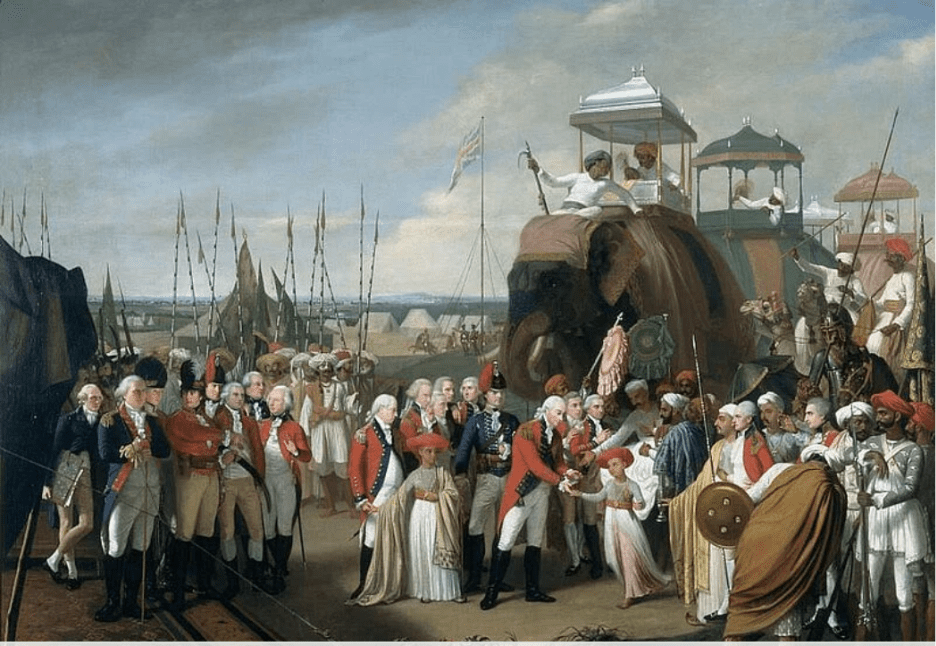
After Tipu Sultan fulfilled all the terms of the treaty, his sons departed Madras on 27 February 1794. Captain Doveton, who was responsible for their care, escorted them. Following a month-long journey, Doveton returned the sons to Tipu Sultan at Devanahalli on 29 March 1794. Although Tipu Sultan regained his sons, he was distressed to find that, over two years, they had changed and abandoned aspects of their religious beliefs.
Following Tipu Sultan’s death during the Siege of Seringapatam in the Fourth Anglo-Mysore War on 4 May 1799, Lord Wellesley relocated the family to Vellore to prevent Tipu’s heirs from serving as a focal point for resistance. The family resided in a palace complex at Vellore Fort under close British supervision. The British provided the sons with generous stipends, hoping they would adapt to a life of luxury and lose interest in revolt.
In July 1806, the sepoys at Vellore mutinied, but the uprising was suppressed within eight hours. Tipu Sultan’s adult sons were accused by the British of instigating the revolt and were exiled to Calcutta. There, they lived in residences assigned by the British and depended on government pensions for the rest of their lives. Meanwhile, many of the zenana women, however, remained in Vellore, where they continued to live as “state prisoners” well into the 1830s and beyond.
Historian Partha Chatterjee described the exile of Tipu Sultan’s sons to Calcutta as “little else but death.” Not all of Tipu Sultan’s sons survived to old age. Only the youngest, Ghulam Muhammad, reached advanced years. He died on 11 August 1872 at the age of 77. After the family’s exile to Calcutta, Ghulam Muhammad was eventually appointed by the British as the official head of the Mysore royal family.
Tipu Sultan’s heirs faced hostage-taking, house arrest, and enforced exile, illustrating how British colonial policy systematically deprived former resistors of power and identity, causing the Mysore dynasty’s legacy to fade.
References:
- Men Without Hats by James W. Hoover
- History of Tippu Sultan by Hasan Mohibul
- Exiles in Calcutta: The Descendants of Tipu Sultan by Bunny Gupta, Jaya Chalia
Leave a Reply