
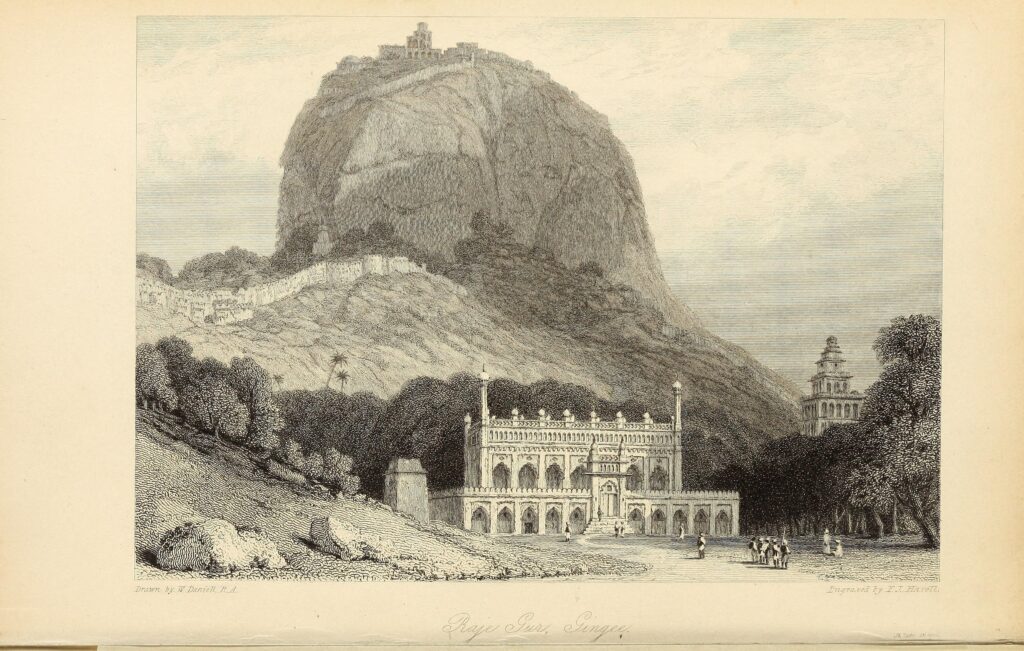
Gingee Fort is one of the few surviving forts in Tamil Nadu, India, and it holds a significant place in India’s history. Located in the Villupuram district, the Fort lies about 160 km from Chennai on the Tindivanam–Thiruvannamalai Highway and about 68 km from Pondicherry. Over the centuries, Gingee has been ruled by the Vijayanagara Nayaks, Islamic Sultans, Marathas, the powerful Mughals, as well as the French and the British. However, when one thinks of Gingee today, the name that most readily comes to mind is Raja Desingh (Tej Singh). Desingh was born to Swarup Singh and his wife, Ramabai.
Desingh Raja ruled Gingee for only about ten months, from January 1714 to October 3, 1714. Though his reign was short, he earned a lasting place in history as one of the most celebrated kings.
After the death of Shivaji’s son Sambhaji, it became evident that Rajaram, Shivaji’s youngest son, could no longer remain in Raigad as the Maratha Empire was steadily collapsing under Aurangzeb’s pressure. On April 5, 1689, Rajaram secretly left Raigad in disguise with a small group to avoid capture and siege, arriving at the Maratha-controlled Fort of Gingee in November 1689. However, Rajaram’s escape to Gingee did not spare him from Aurangzeb’s wrath.
In 1690, Aurangzeb assigned Zulfikar Khan, a prominent Mughal noble and military general, to lead the siege of Gingee in pursuit of the fleeing Rajaram. The siege continued for nine years, from 1689 until its capture by the Mughals in 1698. During this time, the Gingee Fort served as the Maratha capital. When the siege concluded on January 8, 1698, Zulfikar Khan took possession of Gingee and entrusted its charge to one Gussafar Khan.
In 1700, Aurangzeb appointed Swarup Singh, a Rajput chieftain from Bundelkhand (father of Desingh Raja), as the mansabdar and killedar of Gingee Fort. Through the Raja of Bundelkhand, Aurangzeb had secured Swarup Singh’s services and sent him to Zulfikar Khan. Swarup Singh subsequently assumed charge of Gingee Fort from Gussafar Khan. Correspondence sent from Fort St. George, Madras, to England between 1711 and 1714 suggests that he had familial connections to one of the Rajput women in Emperor Aurangzeb’s harem.
Under the Mughal administration, a killedar was obliged to remit the prescribed portion of the revenue collected to the imperial treasury. Swarup Singh, however, failed to meet this obligation. Swarup Singh defaulted on the payments. Meanwhile, in 1707, Aurangzeb died, and his second son, Muhammad Muazzam, who took the title Bahadur Shah I, ascended the throne in Delhi.
Over time, the unpaid arrears accumulated, and Swarup Singh remained a defaulter for nearly ten years. It was reported to the Mughal Emperor, Bahadur Shah I, by the Nawab of Arcot, Zulfikar Khan, and later by his successor, Daud Khan. The debt was formally claimed after Aurangzeb’s death, but Swarup Singh continued to refuse payment.
Bahadur Shah I, the new Emperor in Delhi, was beset by challenges on all sides—from the Sikhs in Punjab and from the Marathas. Taking advantage of this unrest, Swarup Singh paid little heed to his failure to make the required payments.
In 1712, Bahadur Shah I died, and his son Jahandar Shah ascended the Mughal throne in Delhi. On January 10, 1713, at the Battle of Samugarh near Agra, supported by the Syed brothers, Farrukhsiyar, son of Bahadur Shah I’s second son, Azim-ush-Shan, defeated Emperor Jahandar Shah. On the following day, Farrukhsiyar ascended the throne, proclaiming himself Mughal Emperor.
Under the Syed brothers’ dominance, the regime suffered acute revenue losses. Consequently, Swarup Singh was ordered to make arrangements to clear the arrears, but he continued to evade payment.
In the meantime, Sadatullah Khan, the new Nawab of Carnatic, (The terms Carnatic or Carnatak should not be confused with the present state of Karnataka. Historically, the Carnatic region encompassed the present-day states of Tamil Nadu, southern Karnataka, and southern Andhra Pradesh, located between the Eastern and Western Ghats of South India.
The ruler remained patient for some time, repeating his warnings, but to no avail. He then informed the Emperor in Delhi of the situation, submitting a separate statement showing that Swarup Singh’s outstanding dues amounted to seventy lakh rupees. He also filed detailed accounts in support of this claim. Emperor Farrukhsiyar examined the accounts, confirmed that Swarup Singh was a persistent defaulter, and issued orders calling for strict action against him for non-payment. On learning of these proceedings, Swarup Singh was overcome with grief, fell ill, and died shortly thereafter in 1714 without resolving the matter.
On learning that Swarup Singh was ill at Gingee, his son Desingh (Tej Singh) immediately set out from Bundelkhand with his wife, a force of fifty horsemen, and other attendants, and proceeded toward Gingee. On the way, he reached Bednur, which is presently known as Nagara in Karnataka. At that time, the Raja of Bednur was greatly troubled by attacks from the Marathas. Hearing of Raja Desingh’s arrival, the Bednur Raja welcomed him and showed him the letters he had earlier written to Desingh’s father, Swarup Singh, seeking assistance. With Desingh’s help, the Raja of Bednur launched an attack and decisively routed the Maratha forces.
The King of Bednur, incredibly pleased, rewarded Desingh with a lakh of rupees and presented him with an excellent horse from his stables. The horse was known for its fierce and unmanageable nature, and no one else had been able to ride it. However, Desingh personally went to the stables and successfully tamed and rode the horse. Bearing the horse and other gifts of jewels and clothes, Desingh reached Gingee to learn that his father, Swarup Singh, had already passed away.
While English and French records furnish considerable information on Swarup Singh’s reign, they provide scant reliable details concerning his son, Desingh. This paucity of information is likely attributable to the brevity of Desingh’s rule, which lasted only ten months, and to the consequent minimal references in the British records of Fort St. George, Madras, or in the correspondence of the French governor of Pondicherry.
Narayanan Pillai’s book “Karnataka Rajakkal Savistara Charittiram”, found among the Mackenzie’s manuscripts, provides a relatively clear and concise account of Desingh’s history. According to historians, Narayanan Pillai may have obtained first-hand information about Swarup Singh and Desingh from people who had also lived in Gingee during that period.
Desingh immediately assumed the jagir (feudal land) granted to his father by Aurangzeb by right of succession, though it remains unclear whether the Emperor’s decree permitted hereditary succession. The Nawab of Arcot contended that the earlier edict was invalid without the consent of the reigning Emperor. When Paiya Ramakrishna, his secretary, informed him of the legal necessity of having the decree renewed by the new Emperor before assuming the jagir, Desingh replied that he already possessed Aurangzeb’s decree and therefore did not need to apply to anyone else.
Six months after Desingh assumed power, the Nawab of Arcot, Sadatullah Khan, ordered his officer, Lala Todarmal, to go to Gingee and implement the Emperor’s order. Todarmal reached Gingee and set up camp near the Venkataramanaswamy Temple at the base of the Rajagiri hill. The Badushahi officers of the Fort, including Paiya Ramakrishna, came to meet him at the camp. He explained that he had arrived on the Nawab’s orders to confiscate Gingee
and all its attached jagirs if the dues were not paid. They examined the imperial decree and conveyed its meaning to Raja Desingh. Yet, Desingh refused to pay or surrender the Fort, relying on the fact that the imperial decree had been issued to his father by Aurangzeb.
Desingh was advised that he could retain the Fort by meeting and paying respects to Todarmal. Thus, Raja Desingh went to Melachery (Old Gingee) with a large escort of horsemen to meet Todarmal. Seeing Desingh approach, Todarmal advanced to greet him, but Desingh saluted him without dismounting from his horse. Feeling insulted by this behaviour, Todarmal immediately returned to his tent. Yet, being a man of duty and compassion, he overcame his sense of shame and proceeded to Gingee Fort to deliver the imperial edict to Desingh. Enraged, Desingh threw the order to the ground. This act was deemed dishonourable and disloyal, an insult not merely to Todarmal but to the Emperor himself.
Todarmal, maintaining his composure, went to Arcot and informed Nawab Sadatullah Khan of the incident. Enraged by Desingh’s defiance, Sadatullah Khan resolved to invade Gingee, as Desingh’s actions continued to insult both the Emperor and himself. The court officials made every effort to reconcile Desingh with the Nawab, but he refused to entertain any compromise. Ignoring the counsel of his courtiers, he resolved to oppose Sadatullah Khan, relying on the support of his trusted friend Mohabbath Khan, son of the chieftain of Vazhudavur.
On September 6, 1714, Sadatullah Khan sent his vast army towards Gingee and encamped two or three miles beyond the nearby Sarangapani River (other names, Varaha Nadhi, Gingee River). In the force raised by Sadatullah Khan, Kumara Yachama Nayak of Venkatagiri, Venkat Rao of Arani Fort, Nayak of Kalahashthi, Pommaraja, and some Palaiyakars, Khan Sahib of Kallakurichi, and Salapat Khan of Sethupat (near Polur) joined the army. By this, the strength of the military increased to thirty thousand foot-soldiers and five thousand cavalrymen. The English reference states that Desingh’s army consisted of 150 cavalrymen and 500 foot soldiers. In comparison, the Nawab’s army consisted of eight thousand cavalrymen and ten thousand foot soldiers. After a few days, Sadatullah Khan personally joined the forces.
The Nawab’s forces encamped at Kadalimalai, nine kilometers from Gingee, and began raiding the surrounding territory under Gingee’s control. Gradually, the army advanced toward Gingee. Mohabbath Khan abandoned his own marriage preparations and rushed to the Fort’s defence, leading a force of fifty cavalrymen accompanied by two trusted friends.
Those close to Desingh warned that the omens were unfavourable and advised against confronting the Nawab at that time. Ignoring their counsel, Desingh, upon learning that the Nawab’s army was approaching, sent a message to all his followers: they should join him only if willing, and abstain if they so choose. Undeterred, Desingh set out for Arcot, accompanied by Mohabbath Khan and a force of two hundred cavalrymen.
When Desingh reached the banks of the Varagha Nadhi, the river had overflowed its banks due to the rainy season. Growing impatient after waiting for some time, he rode into the flood on horseback. Mohabbath Khan followed with about a hundred cavalrymen, who, despite great difficulty, managed to reach the opposite bank. Though the floodwaters were high, they were able to cross because the river was not very deep. Many officials accompanied them; most were far older than Desingh, yet they refused to abandon him. Had they waited a few hours, the flood would have subsided, allowing everyone to cross the river safely.
Desingh’s small force was thoroughly exhausted after crossing the river and faced great difficulty traversing a muddy swamp. After a march of two and a half hours, they finally reached the Nawab’s camp.
When Sadatullah Khan learned of Desingh’s approach, he dispatched one of his commanders, Daulat Khan, ahead with a force, instructing him to capture Desingh alive. Meanwhile, the Nawab Sadatullah Khan prepared for battle and mounted his elephant.
Daulat Khan, who was leading an army of only about a hundred cavalrymen, on seeing Desingh’s small force, ordered his men to surround them.
Desingh and Mohabbath Khan launched a fierce attack on Daulat Khan’s forces, and both sides suffered losses of 50 men each. Many of Desingh’s soldiers fled, but Mohabbath Khan and his two friends remained close to Desingh, fighting valiantly and slaying many enemies before they too were killed. Left alone, Desingh was enraged and attempted to strike at Daulat Khan atop his elephant. Daulat Khan shouted to his soldiers not to harm Desingh and charged forward on his elephant, trying to capture Raja Desingh alive.
Raja Desingh, riding a horse gifted by the Raja of Bednur, charged at Daulat Khan’s elephant and killed him with a spear thrust. Even after Daulat Khan’s death, Sadatullah Khan did not order Desingh to be killed but advanced on his elephant, demanding that Desingh be captured alive. As Desingh approached, Sadatullah Khan struck and severed the front legs of Desingh’s horse. When the horse collapsed, Desingh was forced to continue the fight on foot.
Even after this, the Nawab wanted Desingh captured alive, so he advanced on his elephant toward him. He was closely followed by Bangaru Yachama Nayak, who also urged his men to capture Desingh. When one of the Nayak’s soldiers tried to capture Desingh, he killed the soldier with his spear. Seeing this, Yachama Nayak ordered an attack, and one of his gunners shot Desingh dead. It happened on October 3, 1714, in Kadalimalai, a village nine km from Gingee. A letter from the Council of Castle St. David’s, dated October 9, 1714, mentions the Battle of Gingee.
The next day, Swarup Singh’s brother sent word to the Nawab, requesting the return of Desingh’s body. Sadatullah Khan, honouring the request, had the body placed in a palanquin and sent to Gingee with due respect. The Nawab, Sadatullah Khan, later came to Gingee and stayed at the Kalyana Mahal. The treasury and other places were secured and sealed.
Sadatullah Khan conveyed a message to Desingh’s wife and others in the Fort, informing them that he had assumed control of the Gingee fort. Desingh’s wife, Ranibai, said that the Nawab was like a father to her and expressed her wish not to live after her husband’s death. According to Rajput custom, she sought permission to ascend the funeral pyre with her husband’s body. Seeing that she was firm in her resolve, the Nawab ordered that her wishes be carried out with due respect. Alup Singh, the nephew of Swarup Singh, performed the final rites. Desingh was cremated on the bank of the Chettikulam tank, which Ram Shetty had excavated during the reign of Rajaram. Rani Bai ascended the pyre and died alongside Desingh.
A few days later, the Nawab allowed Swarup Singh’s brother to retire to a place of his choice. He decided to go to Bundelkhand and was given thirty horses and permission to carry whatever goods he wanted. In addition, a guard of six hundred cavalrymen was sent to transport his riches safely. Desingh’s followers were allowed to continue working during Gingee’s reign, while those who did not wish to stay were sent to Bundelkhand. Sadatullah Khan appointed Sadatyar Khan, his wife’s sister’s husband, as the governor of Gingee Fort, giving him a suitable mansab and jagir.
On the banks of the Chettikulam of Gingee, on the north side, there is a platform where the body of Raja Desingh is believed to have been cremated with full ceremonial honours, in accordance with the orders of Sadatullah Khan. There are mausoleums of Raja Desingh’s friend, Mohabbath Khan, and of Desingh Rajan’s horse in Kadali, Melmalayanur Union. A new city named “Fatepet”, meaning “City of Victory,” was established at the site where Desingh died.
Out of respect for Desingh’s wife Ranibai, the Nawab named a town near Arcot as Ranipet. In recognition of the bravery and sacrifice of young Rajput Desingh and his wife, in 1771, the Nawab of Arcot built memorials for both of them at Ranipet, on the banks of the Palar River.
At the entrance of Rajagiri’s inner Fort in Gingee stands a mosque built by Sadatullah Khan. Both in this mosque and on the wall over the entrance of Gingee’s Pondicherry Gate, Persian inscriptions commemorate the victory of Nawab Sadatullah Khan of Arcot over Raja Desingh and the capture of Gingee Fort.
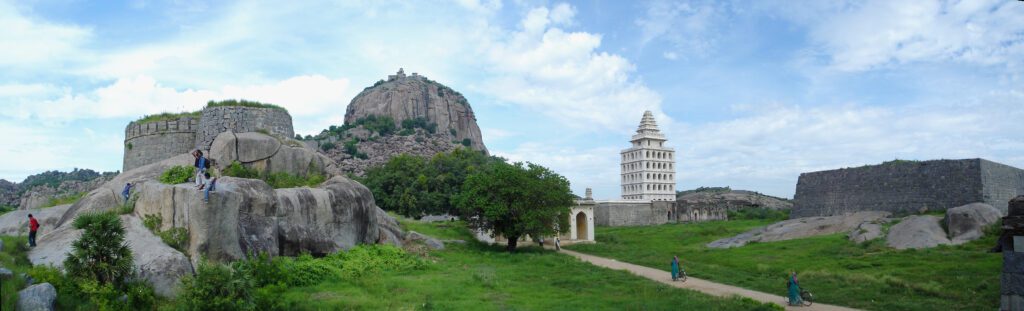
A view of the Rajagiri Citadel (atop the hill), Kalyana Mandapam (white tower) and the Mohabatkhan mosque (right) at the Gingee Fort complex.
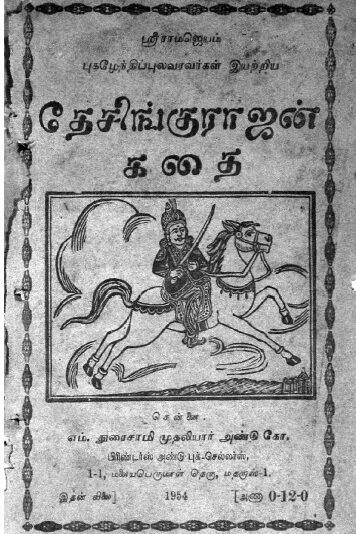
The Desinghu Rajan ballad, which has been sung for generations, remains very popular. However, more than half of it is fictional and bears little connection to historical events. Raja Desingh’s bravery at the age of twenty-two, facing the powerful Nawab of Arcot, Sadatullah Khan, in a seemingly hopeless battle, will always be remembered. Regardless of debates over the ethics of his warfare or whether his cause was right or wrong, his fearless courage and steadfast independence in confronting Sadatullah Khan remain truly admirable.
Reference:
1. History of Gingee and its Rulers by C.S. Srinivasachari
2. Karnataka Rajakkal Savistara Charittiram by Narayana Pillai. General Editor T.Chandrasekharan
Leave a Reply