
Colonel Colin Mackenzie (1754–1821) was a Scottish military officer in the British East India Company and the first Surveyor General of India, a position he assumed in 1815. He was born in Stornoway, located on the Isle of Lewis in the Outer Hebrides of Scotland. He left behind a massive collection of manuscripts and drawings gathered between 1784 and 1821. Collected mainly in southern India, but also in north and east India, Sri Lanka, and Java.
He prepared the first official geographical map of South India and meticulously documented the region’s religious practices, festivals, and social culture. Mackenzie personally visited each location and employed local translators and scholars to conduct field research. Throughout his work, he gathered about 8,000 documents, including oral histories, local chronicles, maps, and manuscripts in about 13 languages. His collection also featured inscriptions, translations, and coins made of gold, silver, and copper from various dynasties, as well as sculptures, paintings, and other artefacts. These collections remain vital to Indian historical and archaeological research, offering insights into the region’s past.
Mackenzie was the first to bring the Vijayanagara architectural heritage at Hampi to broader attention. His twenty-five-volume collection of paintings and drawings of Mahabalipuram is now housed in the British Library. Mackenzie precisely measured and documented the colossal statue of Gommateshwara on Vindhyagiri at Shravanabelagola, Karnataka, which he considered one of his most outstanding achievements. The magnificent statue was built around 981 A.D. and is the tallest monolithic statue in the world (57 ft), carved from a single block of granite.
In 1799, Mackenzie was part of the British army that defeated Tipu Sultan, the ruler of Mysore. After this victory, Mackenzie was put in charge of mapping the Mysore region and the territories ceded to the British by the Nizam of Hyderabad in 1800. This survey lasted from 1799 to 1810. Its main goal was to map the new state borders. His great work of mapping and surveying 40,000 square miles of the country is recounted in his seven volumes of intricate and detailed memoirs of the survey.
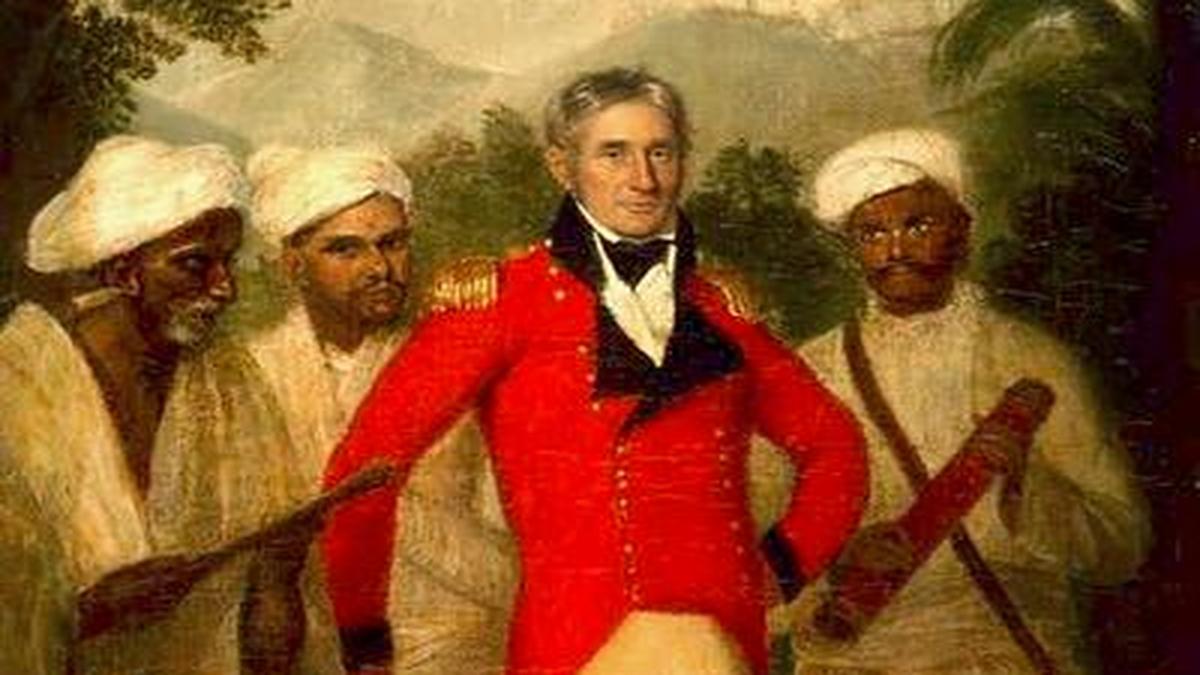
Mackenzie was appointed as the first Surveyor General of India in 1815, a newly established position with its headquarters in Calcutta. However, he was allowed to remain in Chennai until 1818 to complete his survey of South India. He later travelled to Calcutta with his entire collection aboard a special ship, the Sophia, provided by the government.
Colin Mackenzie never returned to his native Lewis and died on May 8th, 1821, at the age of 68, at his home in Calcutta, and was buried at South Park Street Cemetery. Mackenzie left 5% of his estate to his dear colleague, Lakshmiah, and the rest to his wife. Mackenzie sent home the money to build ‘Carn House’ in Stornoway, Scotland, a historic seashore mansion, and on his death, his sister Mary Mackenzie (1747–1827) inherited his entire estate. In 1821, it made her the wealthiest woman in Stornoway.
Mackenzie’s vast collection included “1,568 literary manuscripts; 2,070 ‘local tracts’; 8,076 inscriptions; 2,159 translations; 69 plans; 2,630 drawings; 6,218 coins and 146 images and other antiquities”. The Government of Bengal tentatively suggested a price of Rs 20,000 to purchase the collections from Mackenzie’s widow, Petronella Jacomina. The law firm Palmer and Co. evaluated the collections and determined that Rs 100,000 was a reasonable reimbursement. Subsequently, the Bengal Government acquired these collections. In 1823, Petronella married Lieutenant Robert Page Fulcher at the Cape of Good Hope, a rocky headland on the Atlantic coast of South Africa’s Cape Peninsula. Fulcher was a fellow traveller on the ship to England. Her original plan was to move to Stornoway to live with Colin’s sister.
In 1823-33, the entire Mackenzie collection was sent to England. After Mackenzie’s death, H.H. Wilson, a prominent Orientalist, took on the massive task of cataloguing his collection. On Wilson’s recommendation, most of the manuscripts in South Indian languages were sent back to Madras in 1828. Today, his collection of antiquities—from coins to monumental sculptures—resides in the British Museum and the Victoria & Albert Museum in London. Another significant portion of the Mackenzie Collection is held in the Government Oriental Manuscripts Library (part of the Department of Archaeology, Tamil Nadu).
This includes thousands of palm-leaf manuscripts in Tamil and other South Indian languages.
Mary Mackenzie built a family mausoleum for her parents, her brother Alexander, and Colin. She was not only the richest inhabitant of Stornoway by far, but also one of the most popular, known primarily for her generosity. In her later years, she repeatedly donated large sums to charity. Under the terms of her will, a foundation was established for the town’s poor, along with a further bequest to support a girls’ school. Near her grave in the Ui Church cemetery in Stornoway stands an inscribed memorial to Colin MacKenzie.
References:
1. Colin Mackenzie: Collector Extraordinary (The British Library Journal, 1991), by David Blake
2. Colonel Colin Mackenzie: His Lewis Background and Early Life (Stornoway Historical Society, 1969), by Frank G. Thompson
Leave a Reply